
By Special contributor
RODNEY BAY, St Lucia – Prime Minister Philip J. Pierre is navigating a high-stakes diplomatic balancing act between preserving Citizenship by Investment Programme (CBI) and safeguarding citizens’ visa-free access to Europe’s Schengen Area ahead of a June 2028 mandate. Prime Minister Pierre has chosen to balance national policy (immigration, foreign affairs, security, international scrutiny), economic revenue and political calculations, … “making decisions in the best interests of the people of Saint Lucia.”
Quiet diplomacy after regional shifts
Following regional technical talks in Brussels, the Saint Lucian government sent a formal letter to EU officials. At the November 9, 2026, pre-cabinet press briefing, Pierre confirmed: “The contents will not be released until Brussels formally responds. These discussions have to be held at the level of confidentiality, diplomacy and trust. Saint Lucia values its international partnerships and remains committed to constructive dialogue,” he added.
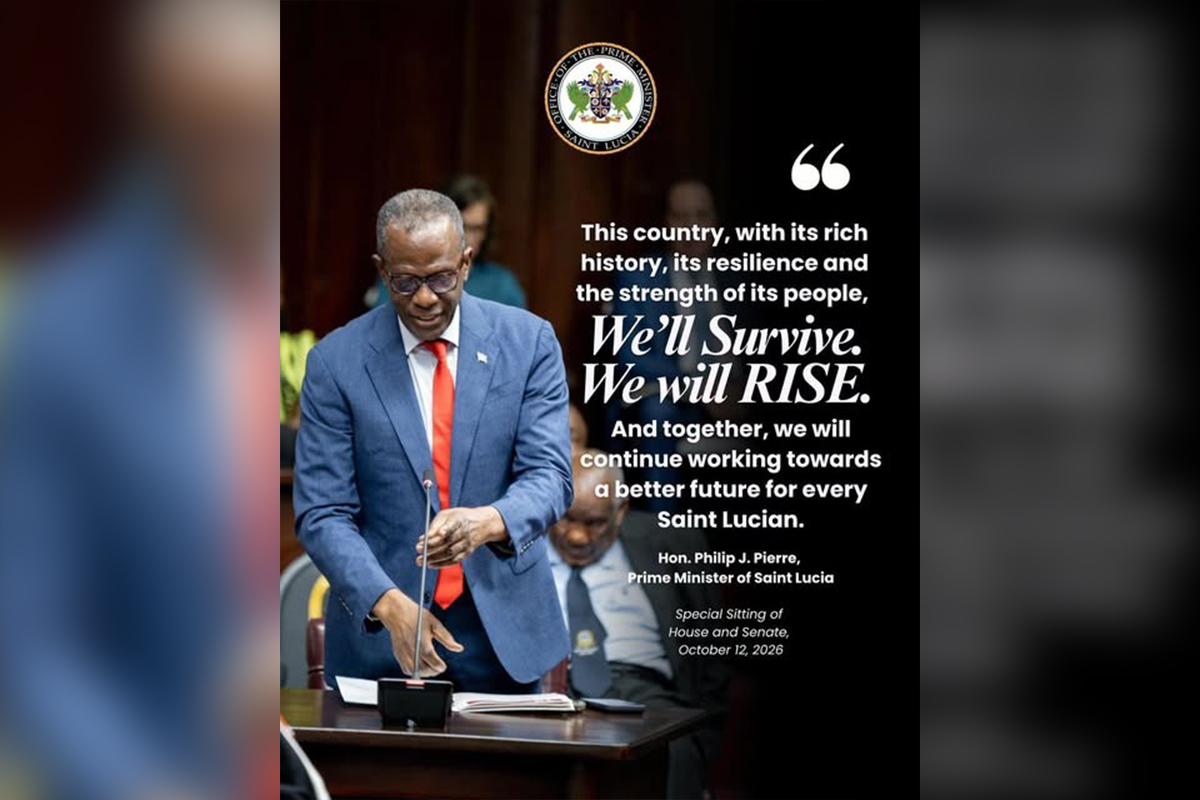
In this delicate geopolitical universe, national policy and Saint Lucia’s modern economic wellbeing intersect beyond government revenue, tourism, education, business travel and the diaspora. It’s about … “working towards a better future for every Saint Lucian,” the prime minister said recently in parliament.
The debate gained urgency after St Kitts and Nevis announced on November 13, 2026, that it would wind down its CBI program, prompting questions about whether other Eastern Caribbean operators would follow. Pierre pushed back against assumptions of a regional domino effect, stating that Saint Lucia will make sovereign decisions based on its own circumstances rather than simply mirroring other countries. “We do not run other people’s countries. We run our own country,” he told reporters on Monday, noting that Saint Lucia continues to negotiate with European officials.
Economic and employment value
The Prime minister defense of the program’s domestic value underscores why the stakes are so high. He argued that the program remains vital to the island’s development and cautioned critics against celebrating its potential demise, highlighting that the program directly employs 30 people (supporting roughly 120 family members).
Furthermore, CBI contributed approximately XCD 65 million (USD 24 million) to the Consolidated Fund in the previous year. Saint Lucia’s budget reliance on CBI remains comparatively modest, below 10 percent, even as Saint Lucia’s gross CBI revenue was reported at XCD 402.2 million in 2024/25 before due diligence and large commission expenses.
“ Revenue from CBI has given my government greater room to respond to the rising cost of living. As higher prices for food, fuel and other essentials have placed pressure on household budgets, this revenue has helped us ease some of that burden while continuing to fund public services and programmes that Saint Lucians rely on,” the finance minister illustrated.
In the context of regional dependency on CBI revenue, Pierre reiterated that Saint Lucia “is less reliant on the revenue.”
Saint Lucia is the least fiscally dependent Caribbean CBI island, assigning no more than 10 percent of revenue to budgetary allocations, unlike other Caribbean islands—where CBI revenues have historically constituted a massive share of national budgets.
The transition challenge
From a tactical and economic standpoint, Pierre’s logic is sound — not introducing CBI non-tax revenue as an economic pillar, but as a supplementary source for public finances and capital projects. With some degree of elasticity among the five Eastern Caribbean operators, Saint Lucia has relative insulation and unique leverage.
Prime Minister Pierre’s delicate balancing act, his shrewd statecraft and political wit, has so far decoupled Saint Lucia from the five Eastern Caribbean CBI operators, signalling that Saint Lucia will not be hurried into a premature admission without extracting meaningful concessions or transition terms.
The EU CBI mandate is enshrined in law. Its supplementary decision hinges on what happens next; it is a deep-seated public anxiety that impacts national sovereignty, visa-free access, trade in services, and public finance.
The rationale
Across the region, citizens are watching their governments respond to Brussels with different playbooks. Critics and outside observers remain divided over how much room Saint Lucia actually has to manoeuvre.
The Opposition leader, Allen Chastanet, and his counterparts’ partisan noise are locked in with a potential political weapon. Equally troubling is the approach to financial accountability. Numbers don’t lie.
Prime Minister Pierre has pledged a line-by-line accounting of CBI spending on national security and healthcare, infrastructure, and social development, sufficient to quell public scepticism. Saint Lucia expects diplomacy and public patience to bring about visible results, while the prime minister is keeping his cards close to his chest, anticipating a softer landing and a viable alternative from Brussels in development financing, climate and concessionary finance.
Saint Lucia is taking a calculated gamble that Brussels responds favourably to confidential diplomatic overtures and small states’ challenges. However, should the EU holds firm to its June 2028 mandate, the loss of lucrative non-tax revenue and/or visa access has the potential to further question confidentiality, diplomacy and trust.
The core challenge
Saint Lucia’s national strength, operating in a modern geopolitical and economic space, requires focus to navigate the CBI tightrope, with careful balance.
Lively political theatre and public spectacle will not eclipse the few alternatives to match CBI’s low overhead, or windfall size over a short window.
A contingency plan to build broad domestic consensus beyond the June 2028 deadline holds the potential to extend leverage and disciplined statecraft. Even if Saint Lucia negotiates a transition or winds down the program gradually, analysts note that replacing high-margin, short-window CBI inflows takes time.
The prospects of clean energy, regional export potential, food security, high-value tourism, “Tourism 2.0,” digital transformation, connectivity, and services trade are core challenges to bridging the gap, typically requiring shock absorbers for 3-5 years before delivering comparable returns.
The true cost of losing CBI is not knowing what should have been done; it is the practical reality that replacement and new revenue require tough measures.
In the interim, fiscal discipline, tighter spending prioritisation, modernisation of business licensing and regulatory frameworks, improved public financial management, trade integration and tax efficiency raise the stakes for domestic recovery.
CBI receipts reportedly accounted for roughly 4.3 percent of GDP and 14.5 percent of government revenue across the Eastern Caribbean Currency Union (ECCU) in 2025.
Fiscal stability, public investment, and timely economic data are paramount to defining post-CBI economic resilience. Similarly, the timing and scale of fiscal and structural policies are paramount. Given Saint Lucia’s distinct position within the Eastern Caribbean, avoiding immediate friction across mobility headwinds, tourism, trade, finance and investment inflows requires prioritisation.
Prime Minister Pierre has declared:
“In overseeing the CBI and all national policy issues, we will keep making decisions that benefit the Saint Lucian people,” reinforcing what he said previously, “ This country, with its rich history, its resilience and the strength of it people, will survive. We will rise.”
About the Author