
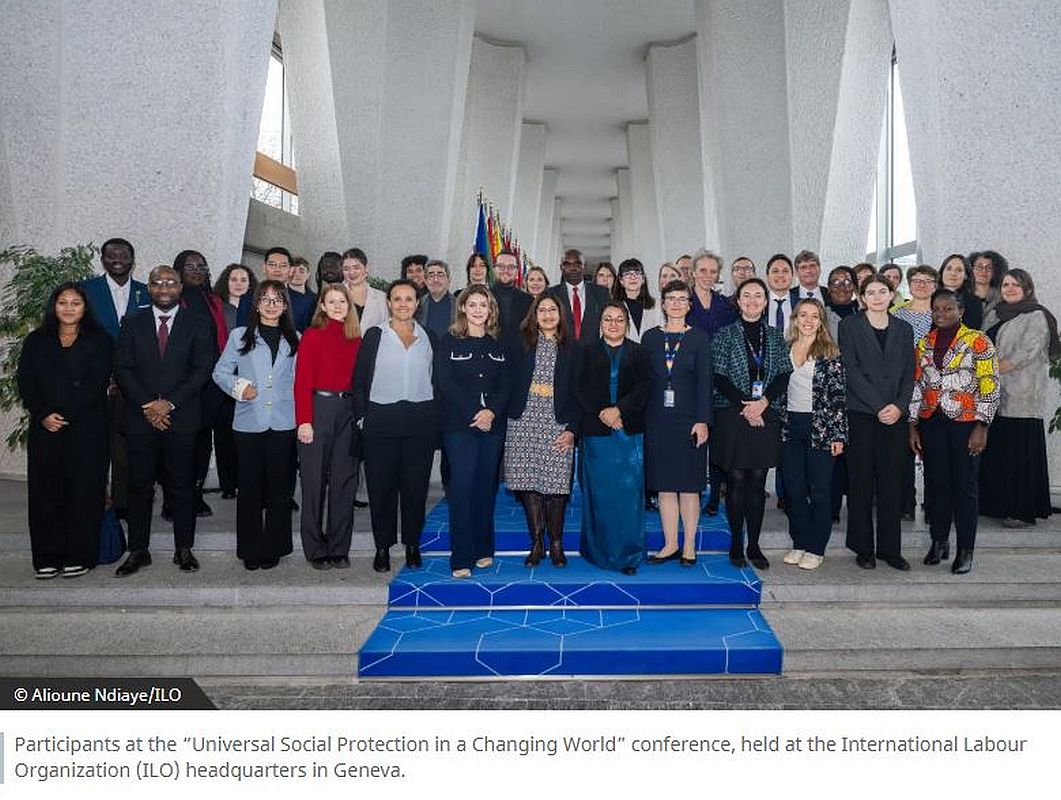
Participants at a conference convened under the Global Partnership for Universal Social Protection (USP2030) emphasised the urgent need for better social protection amid growing global challenges.
GENEVA, Switzerland (ILO News) – Translating political commitments and national social protection strategies into reality is key to achieving universal social protection. Governments, workers’ and employers’ organizations, international institutions and civil society representatives meeting at the International Labour Organization (ILO) headquarters in Geneva on 4 November made this call while attending the Universal Social Protection in a Changing World: Advancing Social Development and Decent Work conference.
Organised by the ILO, the World Bank and the Friedrich-Ebert-Stiftung under the Global Partnership for Universal Social Protection to Achieve the Sustainable Development Goals (USP2030), the gathering focused on strengthening political commitment, national policies and an enabling global environment for universal social protection.
A changing global context makes social protection more essential than ever
Climate change, demographic shifts, technological transformation and widening inequalities are increasing the need for comprehensive social protection systems, while growing debt burdens, constrained public budgets, violent conflicts and declining development assistance are limiting countries’ capacity to invest in them.
According to the ILO’s World Social Protection Report 2024–26, only 52.4 percent of the world’s population is covered by at least one social protection benefit, leaving 3.8 billion people unprotected.
Referring to the reduction of income inequality in Scandinavian countries during the 20th century, Lucas Chancel, co-director of the World Inequality Lab at the Paris School of Economics, said:
“It’s a huge compression of the income scale that was made possible thanks to the rise of social protection, thanks to progressive taxation. And this can very much be prolonged in the future with a new agenda for tax redistribution, for social protection.”
Jayati Ghosh, Professor of Economics at the University of Massachusetts Amherst and co-chair of the Independent Commission for the Reform of International Corporate Taxation, said:
“We do not push enough the macroeconomic benefits and the growth and development benefits of social protection, but this is really important.”
From political commitments to national social protection policies
Political recognition of social protection has grown significantly. At the Second World Summit for Social Development in Doha in 2025, governments reaffirmed that national social protection policies and strategies constitute essential frameworks for translating political commitments into reality, by progressively extending coverage, improving benefit adequacy and strengthening social protection systems.
The need for a comprehensive approach that supports pathways from cash transfers into decent and productive employment with social security, was also highlighted by Peter Ombasa, assistant director of the National Social Protection Secretariat of Kenya, “Cash transfer is good. It is a short-term strategy, but in the long-term, we need to build capacity of our beneficiaries”.
From policies to implementation: Closing the gap
Effective implementation requires sustained political leadership, adequate, predictable and sustainable financing, strong institutions and delivery systems capable of reaching people throughout their lives, including during crises.
Country experiences highlighted the importance of extending social security to those in the informal economy and fostering transitions to formality.
“We need simple registration, flexible contribution and publicly financed support for the workers who cannot afford regular payments. Universality means everyone must have access to protection according to their need and capacity,” said Smritee Lama, secretary general of foreign affairs of the General Federation of Nepalese Trade Unions from Nepal.
Social protection must also adapt to people’s changing needs as they move through different stages of life, change jobs, recalled Pierre Vincensini, special advisor at the International Organisation of Employers. “Equally important is to adapt protection to labour market transitions”, he said.
Civil society perspectives emphasised participation, accountability and the need to translate commitments into tangible improvements in people’s lives.
Closing the conference, Valérie Schmitt, chief of the ILO Universal Social Protection Branch, emphasised the need for coherent national policies, sustained investment, strong institutions and international cooperation to turn political commitments into effective access to comprehensive and sustainable social protection systems that leave no one behind.
“Universal social protection is key for social justice, redistribution and fair transformations,” Schmitt said.
About the Author