

- The region is expected to grow by 2.5% in 2027. Lower growth in employment, a slight increase in inflation, the perspective of more costly financing, as well as possible effects of El Niño could affect that recovery.
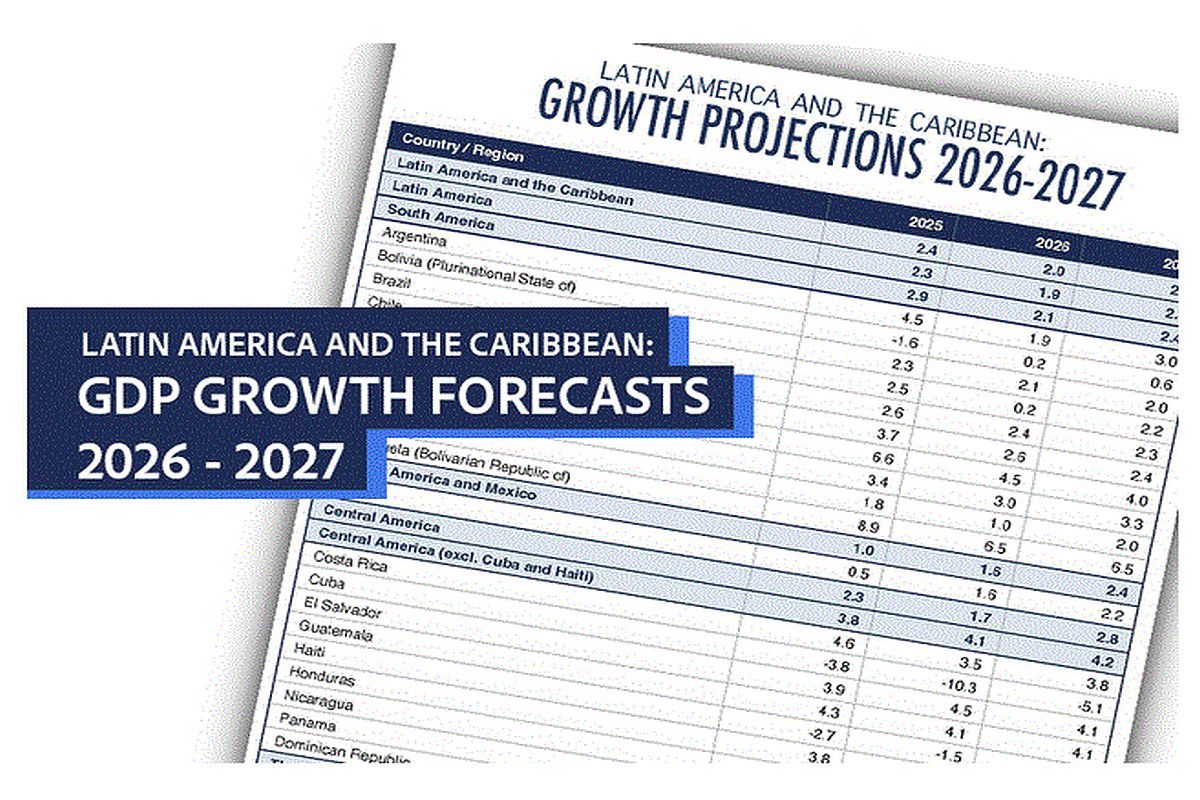
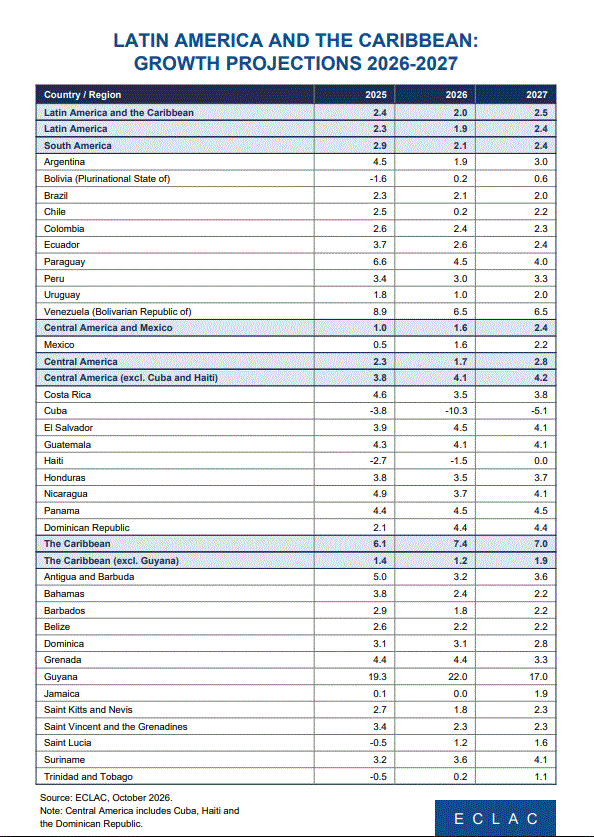
SANTIAGO, Chile – The Economic Commission for Latin America and the Caribbean (ECLAC) projects that the regional economy will grow by 2.0 percent in 2026 and by 2.5 percent in 2027, as stated in a press release published today. These figures, compared to 2.4 percent growth in 2025, point to a deceleration during the current year and a moderate recovery the following year, in an international context of increased uncertainty.
As ECLAC indicated in its report International Trade Outlook for Latin America and the Caribbean, 2026, presented on 15 October, geopolitical tensions, disruptions in logistics routes, and decreased predictability of trade policy are reconfiguring the landscape in which the region’s economies operate.
In this context, external shocks affect conditions of external demand and increase production and import costs, particularly due to the increase in energy and food prices. The consequences are heterogeneous: while some commodity exporters may benefit from increased prices, import economies face pressure on their costs and on household purchasing power.
In the labour market, employment continues to grow, though at a lower rate. This loss of growth limits the expansion of household income and consumption and hinders progress in the reduction of labour gaps and informality. Lower job creation is therefore an additional transmission channel of the deceleration of internal demand.
For its part, inflation shows a slight trend toward increase amid rising energy and food prices. These pressures impact production and transportation costs, especially affecting households that allocate a larger proportion of their incomes to essential goods.
In addition, international financing is expected to become more expensive, given greater worldwide inflationary pressures. This has led to increases in the interest rate in the United States, with an increase of 25 basis points in September, the first in three years, and by the European Central Bank, which applied increases in June and September of 25 basis points each. These increases raise the cost of financing for governments, companies, and consumers, with effects on debt service and investment. Inflationary pressures and higher global interest rates could reduce leeway for flexible monetary policy in the region’s economies.
The predictions show significant differences between subregions. South America is expected to grow by 2.1 percent in 2026 and 2.4 percent in 2027. In Central America, 1.7 percent growth is expected in 2026 and 2.8 percent in 2027. This result is influenced by the performance of Cuba and Haiti. If these two economies are excluded, the subregional average would be 4.1 percent for 2026 and 4.2 percent for 2027. In the Caribbean, growth is expected to reach 7.4 percent in 2026 and 7.0 percent in 2027, with a marked impact by the performance of Guyana. When this country is excluded, rates predicted for the Caribbean are 1.2 and 1.9 percent respectively.
Greater growth is expected in 2027 in an environment marked by persistent risks in the international context and the possible impacts of the El Niño phenomenon. This prediction will be affected by the evolution of worldwide demand, commodity prices, and international financing conditions, as well as the capacity of the region’s economies to sustain consumption and investment.
In this landscape of low growth, ECLAC reiterates its ongoing calls regarding the importance of scaling productive development policies (see the Panorama of productive development policies in Latin America and the Caribbean, 2025), as well as promoting integrated strategies of productive formalisation (see the Economic Survey of Latin America and the Caribbean, 2026). To achieve this, ECLAC proposes driving agendas that coherently coordinate labour, fiscal, financing, and productive development policies that allow for reformulating their orientation toward strengthening productive capacities and promoting formal and high-quality employment, thereby contributing to increasing productivity, accelerating growth, and progressing toward more productive, inclusive, and sustainable development.
About the Author