



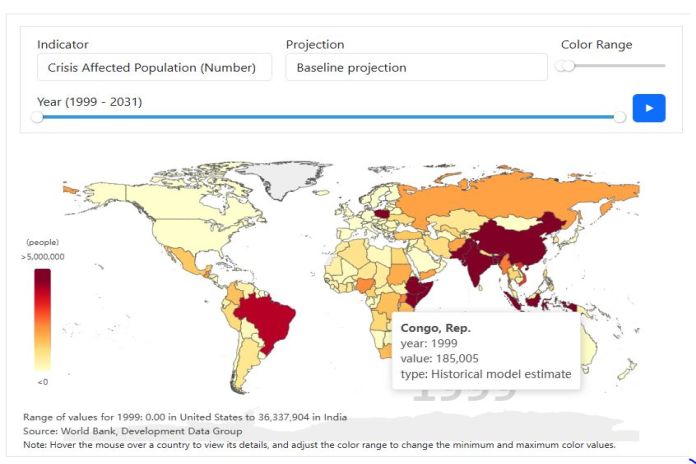
- Conflict reignited in the Middle East in late February 2026, sending energy prices sharply higher and widening macroeconomic uncertainty. The April 2026 World Food Security Outlook projects that severe food insecurity will exceed one billion people globally by 2028, with the 2030 estimate revised upward by 46 million people relative to the October 2025 outlook. Yet food-security projections have operational value only when they rest on a credible evidence base. That evidence base is weakening.
By Bo Andree, Daniel Gerszon Mahler, Umar Serajuddin and Zacharey Carmichael
A critical forecast built on eroding data
Earlier this year, the Global Report on Food Crises, which tracks Integrated Food Security Phase Classification (IPC) assessments globally, confirmed famine (IPC Phase 5) in parts of both the Gaza Strip and Sudan — the first time two famines have been recorded simultaneously since IPC reporting began. These are situations where immediate action is required to save lives. Yet the report also recorded its lowest country coverage in a decade. Of the 65 countries and territories selected for analysis, 18 had no acute food insecurity data, or no data meeting technical requirements. The report attributes these gaps to restrictions on data collection or sharing, limited funding, and insufficient priority given to data collection.
Overlaying the report’s country set with the April 2026 IPC Phase 3+ estimates suggests that around 44 million people in 2025 were living in crisis-affected areas in countries without eligible data, out of an estimated 335 million across the full sample.
Nearly one in three people living in crisis-affected areas were outside official monitoring coverage worldwide.
The same deterioration is visible across the broader humanitarian data ecosystem. The Centre for Humanitarian Data’s 2026 State of Open Humanitarian Data finds that data availability across 22 humanitarian operations fell to 68 percent, down from 74 percent the previous year. Food security was the weakest of the six categories assessed, at 46 percent.
The report found that operational capacity is also weakening. In some contexts, enumerator and key-informant networks built over many years have been disbanded. The Office of the United Nations High Commissioner for Refugees and the International Organization for Migration reported reductions of around 40 percent in data-related staff as of early 2026, while World Food Programme household interviews fell from 1.1 million in 2024 to 800,000 in 2025, a decline of roughly 30 percent. Preliminary reporting from West and Central Africa suggests that the erosion is continuing into 2026: in the March 2026 Cadre Harmonisé round, only two of 18 countries were able to support the IPC process with primary data collection.
These gaps matter directly for the April 2026 World Food Security Outlook, the World Bank’s most recent quarterly update on the current and projected state of global food security. Its estimates rest on three layers of evidence: macroeconomic projections, historical development indicators, and acute food-security monitoring. Each is under strain.
The Food Insecurity Experience Scale has weaker coverage in many fragile and conflict-affected settings, where deterioration in acute food-security monitoring has been sharpest. FEWS NET went offline in January 2025 following the US government’s pause on foreign assistance. The interruption lasted through June 2025 and affected both the February and June assessment cycles. As a result, only one of the three regular annual cycles informed the April 2026 preliminary estimate for 2025.
At the macroeconomic layer, the IMF outlook supplies the population, GDP growth, and inflation projections. These projections draw on Article IV consultations. When consultations cannot be conducted, governments stop reporting, or conflict prevents data collection, reliability falls and estimates must rely more heavily on alternative sources and imputation. Where official inflation data are unavailable, the partially modeled Real-Time Food Prices system helps fill gaps in the inflation series.
The historical development indicators are also under pressure. Poverty inputs come from the World Bank Group’s Poverty and Inequality Platform and depend on survey systems whose frequency and coverage have weakened. In 6 out of 10 low- and middle-income economies, the most recent poverty survey is now more than five years old.
When the underlying information is limited, statistical models have limited power, regardless of how advanced the method is. No amount of algorithmic sophistication can resolve basic uncertainty about whether conditions are changing, where they are changing, or by how much.
The cost of data deprivation
Food security projections and the underlying data architecture have informed decisions at scale. The Outlook’s financing-needs series, which estimates the cash value required to cover 25 percent of minimum energy dietary needs for the affected population, was developed to inform the IDA pandemic needs assessment. Later projections informed the World Bank Group’s crisis response, which mobilized US$45 billion across IDA economies; the IDA 21 Crisis Response Window has been activated in ten countries to date.
The same data architecture, applied at higher frequency through the Joint Monitoring Report, supported the first activation of Somalia’s National Preparedness Plan in February 2026. The activation mobilised US$50 million from the IDA Crisis Response Window for early response, complemented by a USD 35 million IDA grant for the Somalia Bulsho project and 63 million euros from the European Union. The Food and Agriculture Organization, the World Food Programme, and other partners are coordinating under the preparedness plan to protect 1.8 million children at risk of acute malnutrition.
When data systems weaken, response weakens as well. Crisis thresholds become harder to calibrate and monitor, financing needs become harder to size, and early-response decisions face larger margins of uncertainty and longer delays.
The consequences of delayed or poorly targeted responses are significant. Malnutrition in utero and during early childhood shapes lifetime outcomes, including stunting, lost schooling, lower earnings, and higher adult health risks, as documented in the World Bank Group’s 2023 Altered Destinies report. When data gaps delay response, more children pass through the critical first 1,000 days without adequate support. The cost is compounded over time through weaker human capital, smaller future economies, and lower returns on decades of development investment.
Sustaining food-security data systems — surveys, price monitoring, and assessment capacity — costs millions. The decisions they inform are measured in billions. Cutting data systems is not a cost saving. Efficiency starts with better information, not less of it.
The April 2026 World Food Security Outlook and interactive maps are publicly available through the World Bank Microdata Library.