



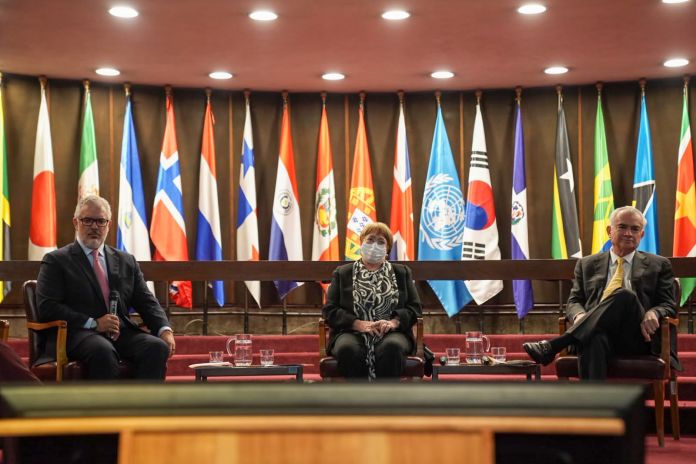
SANTIAGO, Chile – The Commission on Geopolitics, Globalization and Development for Latin America and the Caribbean, convened in late 2024 by José Manuel Salazar-Xirinachs, executive Secretary of the Economic Commission for Latin America and the Caribbean (ECLAC), today presented its report, Ruptures and Opportunities: Proposals for Latin America and the Caribbean to Thrive in the New Geopolitical Era, at a high-level event held at the United Nations entity’s headquarters in Santiago, Chile.
The Commission, co-chaired by former President of Chile, Michelle Bachelet and former President of Colombia, Iván Duque, brings together 13 distinguished figures from Latin America and the Caribbean, North America, Africa, Asia and Europe, who participated in their personal capacities and on an ad honorem basis. The Commission’s work was undertaken with the support of United Nations secretary-general António Guterres.
The report’s central message is that the world has changed and that Latin America and the Caribbean has the assets needed to navigate this new geopolitical era successfully. The Commission identified eight ruptures that are reshaping the global order and are unfolding simultaneously:
- Globalisation reconfigured: from economic efficiency to security. Economic interdependence, once celebrated and viewed as a source of stability and efficiency, is increasingly viewed as a source of vulnerability and is being used as an instrument of power and coercion.
- The erosion of multilateralism and the reconfiguration of global governance. The post-war multilateral system is weakening, and what is emerging is a more fragmented form of governance, characterised by selective alliances and competing platforms.
- From unipolar hegemony to multipolar competition. The world is transitioning from a unipolar system dominated by the United States to one of asymmetric multipolar competition.
- Soft power reconfigured. Soft power is becoming increasingly important as a component of States’ global presence. The soft power of the United States is declining, while that of China is on the rise.
- Global decline of democracy and rising political polarisation. The erosion of democracy is accompanied by growing political polarisation worldwide. The proportion of countries classified as liberal democracies is declining.
- Disinformation and the crisis of truth in the age of AI. Disinformation, algorithmic manipulation and the malicious use of artificial intelligence are undermining trust in institutions, fuelling polarisation and weakening democratic legitimacy.
- Backlash against women’s rights, gender equality and inclusion. Advances achieved in these areas over recent decades are facing growing contestation and, in some contexts, reversal.
- End of the global climate consensus.Climate action is increasingly being subordinated to national industrial strategies, energy security concerns and geopolitical competition. In some sectors, the scientific consensus is being questioned.
Against this backdrop, the Commission maintains that the region has a set of assets whose strategic value has increased in the current geopolitical context. These include its abundant natural resource endowments; its productive, human and financial capabilities; the size of its market; its status as a region free of nuclear weapons and inter-state wars; and its intangible assets (soft power). These assets provide the region with a significant opportunity to advance its development and enhance its international presence and influence.
The report notes, however, that these assets will not spontaneously translate into development gains: this will require clear strategies, strong institutions and effective governance. To that end, ten recommendations organised around three pillars are presented: seizing the moment by activating strategic assets; strengthening governance, institutions and democracy; and energising international and regional agency.
The report highlights that Latin America and the Caribbean account for 46 percent of global lithium reserves, 35 percent of copper reserves, 28 percent of graphite reserves and 23 percent of rare earth reserves. The region is also the world’s largest net food-exporting region, hosts nearly half of the planet’s terrestrial biodiversity and one third of its freshwater resources, and has the world’s cleanest electricity matrix. The report also notes that the regional market, with more than 660 million people, can serve as an engine of productive diversification. However, intraregional trade currently accounts for only 14 percent of the region’s total goods exports, one of the lowest rates globally.
José Manuel Salazar-Xirinachs, executive secretary of ECLAC, said that the title of the report encapsulated its main message: the ruptures suggest that the world had changed, and that, in turn, called for a new playbook to seize the opportunities through innovative development and international engagement strategies. The 10 ten proposals presented in the report provide a concrete road map for mobilising assets to generate development gains and strengthen the international presence of the countries of the region.
The report states that none of the recommendations can be implemented without effective governance and strong institutions, and points to the need to strengthen the fiscal capacity of the State and to address organised crime as a regional governance priority, and not only as a security issue.
Michelle Bachelet, former president of Chile and co-chairperson of the Commission, said that the region’s wealth lies not only beneath the ground and on the land, but also in its people and industries. She said that Latin America and the Caribbean has productive, human and financial capabilities that deserve to be valued for their full worth and great potential. The region also has political influence, although this is not always easy to recognise or understand, and its diversity, cultural heritage, influence and visibility in the world give it a form of influence that it must learn to harness.
The report underscores that regional cooperation can be a powerful tool for transforming assets into development gains, and that it does not require unanimity. Given the high degree of political polarisation in the region, the recommendation is to prioritise functional cooperation among countries willing to move forward on specific issues, with clear objectives, time frames and responsibilities.
The report also notes that expanding the region’s international influence requires avoiding rigid alignments in the rivalry between China and the United States and, instead, building variable-geometry coalitions with partners that share specific interests. It also highlights the need to develop new geopolitical analysis capabilities across government, business and academia.
Iván Duque, former president of Colombia and Co-Chairperson of the Commission, said that the challenge is to strengthen the region’s capacity to diversify its partnerships and defend its strategic interests. A region capable of acting collectively is better positioned to maintain mutually beneficial relations with the world’s major powers without becoming subordinate to any of them. The proposal, he added, is neither directed against any country nor aligned with any particular bloc, but seeks instead to create space for the region to act and make its own decisions.