



-
- IDB Invest provides financing to Banco Santander Brasil to support sustainable agriculture, land restoration efforts, and resilient infrastructure.
WASHINGTON, USA – The Eco Invest Brasil Program recognises a simple reality: public capital alone is insufficient to finance Brazil’s resilient development. What is required is an environment that allows private investors to participate on reasonable terms – reducing risk, aligning incentives, and creating scale.
Eco Invest combines blended finance, currency hedging mechanisms, and competitive auctions to attract long-term private investment for sustainable agriculture, land restoration, and resilient infrastructure. Banks and other financial institutions compete for access to public funds, with bids evaluated primarily on their ability to mobilise the largest volume of private capital.
Banco Santander Brasil, one of the largest financial institutions in the country, participated in the first two Eco Invest auctions. While the bank has broad access to funding, the challenge lies in mobilising long-term foreign capital at scale for Eco Invest’s priority sectors.
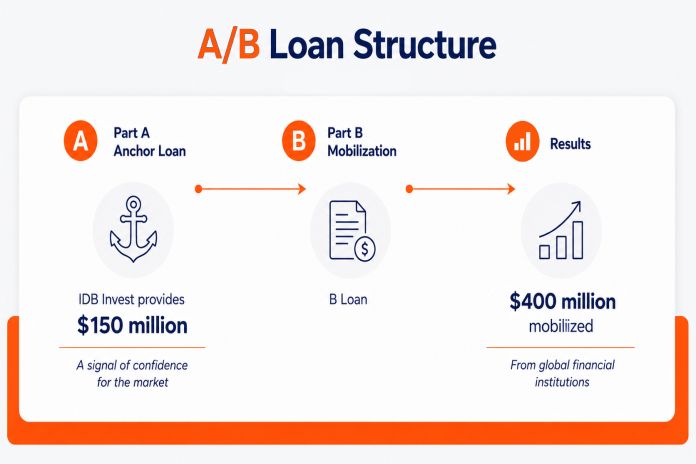
To address this challenge, IDB Invest provided a loan to Banco Santander Brasil, with a tenor of up to five years and a maximum amount of $150 million, while mobilising an additional $400 million from international B-lenders with shorter tenors. By acting as Lender of Record, IDB Invest extends its preferred-creditor status and contractual framework to private investors – thereby significantly enhancing risk mitigation and investor confidence.
How Eco Invest auctions channel capital through banks to projects
Eco Invest’s blended finance auctions operationalise a simple mechanism: public catalytic capital is allocated competitively to local financial institutions, which then mobilise private capital (including external funding) and on-lend to eligible projects, subject to defined eligibility, safeguards, monitoring, and reporting requirements.
Mobilising additional private capital, not replacing it
Santander’s funding profile is robust, supported by a large deposit base and diversified market access. As such, the value of this transaction lies not in providing access to capital but in mobilising additional private investment and extending tenors.
The A/B loan enables Santander
- Secure longer-term funding aligned with the cash-flow profile of resilient assets;
- Mobilise private international capital at scale under Eco Invest requirements;
- Strengthen its participation in Eco Invest auctions, where mobilisation ratios are a key success metric.
In practice, the transaction demonstrates how multilateral capital can be used not to crowd out private funding, but to catalyse it – bridging the gap between investor appetite and project needs.
Aligning finance with impact
The proceeds of the A/B loan will support financing for projects eligible under Eco Invest, including:
-
- Sustainable agriculture and livestock;
- Restoration and productive use of degraded land;
- Resilient infrastructure aligned with national development priorities.
At a higher level, the transaction contributes to:
-
- Mobilising private capital for aligned investments;
- Supporting Brazil’s land restoration goals across multiple biomes;
- Demonstrating a replicable model for scaling sustainable finance in emerging markets.
A model for emerging markets
As highlighted by the OECD, Eco Invest offers a replicable model for emerging economies seeking to mobilise foreign capital while managing currency risk. The Santander A/B loan shows how this framework can be operationalised through well-designed financial intermediation that combines public and private resources in a disciplined, market-oriented way.
For IDB Invest, this transaction reflects our Originate-to-Share approach: originating complex, high-impact transactions, structuring them to meet market requirements, and then bringing in private investors to scale impact.
In doing so, we help turn investment priorities into bankable projects – and demonstrate that with the right structures, private capital can play a decisive role in financing resilient growth.