



-
- The agreement builds on the commitments set out in the Letter of Intent signed in June 2026 by Brazil, Guyana and IICA, which promotes the establishment of a Sustainable Agriculture Hub of the Americas in the Caribbean country.
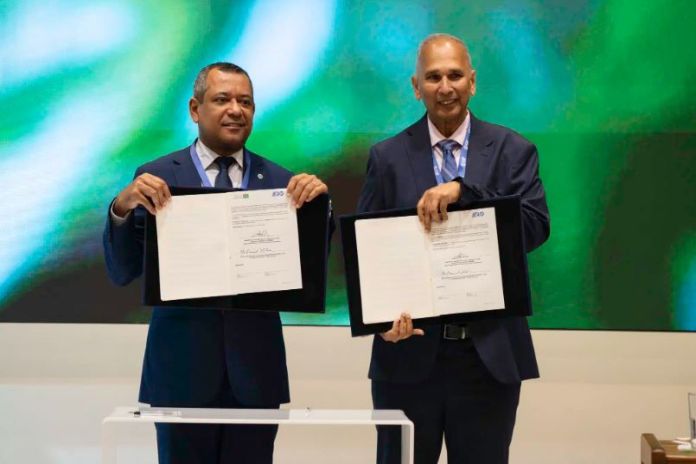
SAN JOSE, (IICA) – Brazil’s Ministry of Agriculture and Livestock (MAPA) and the Inter-American Institute for Cooperation on Agriculture (IICA) signed an agreement to accelerate the transfer and adaptation of technologies, strengthen scientific capacities and promote innovative solutions for tropical agricultural systems, with a particular focus on the Caribbean region.
The agreement builds on the commitments established in the Letter of Intent signed in June by MAPA, the ministry of agriculture of the cooperative Republic of Guyana and IICA, under which the parties agreed to promote the establishment of a Sustainable Agriculture Hub of the Americas in Guyana. The Hub is envisioned as a regional platform for technical cooperation, science, technology and agricultural innovation.
The agreement was signed by Cleber Soares, Brazil’s deputy minister of agriculture, and Muhammad Ibrahim, director general of IICA, during the meeting of the Institute’s Executive Committee, the governing body composed of ministers of agriculture from countries across the Americas, held in San José, Costa Rica.
The agreement will strengthen coordination among MAPA, the Brazilian Agricultural Research Corporation (EMBRAPA), IICA and other regional partners, including the National Agricultural Research and Extension Institute of Guyana (NAREI), the Caribbean Agricultural Research and Development Institute (CARDI) and the Caribbean Community (CARICOM).
“Through this Hub, EMBRAPA and Brazilian experts will contribute their experience, technologies and knowledge across a range of crops and production systems so that, together, IICA, Brazil and the Government of Guyana can advance the development of agriculture and livestock production in the Caribbean and Central America,” said Soares.
The IICA director general emphasised that the center of excellence to be established in Guyana will leverage Brazil’s extensive experience as a global leader in tropical agricultural innovation.
“As outlined in the Institute’s 2026-2030 Medium-term Plan, approved by the ministers of agriculture during this executive committee meeting, technical cooperation will be tailored to the diversity of production systems across the Americas, with particular emphasis on the transfer of innovations, technologies and science-based solutions,” Ibrahim added.
The agreement identifies several priority areas for cooperation, including research and technology transfer for sustainable tropical agriculture; strengthening technical capacities; enhancing food security, productivity and production diversification; agricultural risk management; the sustainable use of natural resources; agricultural health; the prevention of transboundary pests and diseases; and collaboration with technical organizations in the Caribbean and other regions.
It also establishes mechanisms to facilitate the participation of additional institutions and the incorporation of new areas of work, with the goal of consolidating a stable and replicable cooperation platform capable of addressing the challenges facing tropical agriculture.
The proposal to establish the agricultural innovation Hub in Guyana was presented in June to the country’s president, Mohamed Irfaan Ali.
At the time, president Ali said the initiative seeks to position Guyana as a major food supplier for the Caribbean and to accelerate the transformation of agriculture in both Guyana and the wider region through new technologies that create added value, strengthen climate resilience, support seed production and build a technical ecosystem that enhances food security.