

Goods trade holding up despite Middle East conflict and high energy prices
 GENEVA, Switzerland – Global merchandise trade appears to have remained resilient in the first half of 2026 despite headwinds from the ongoing conflict in the Middle East, which seem to have been partly offset by rising demand for electronic components related to investment in artificial intelligence, according to the latest WTO Goods Trade Barometer.
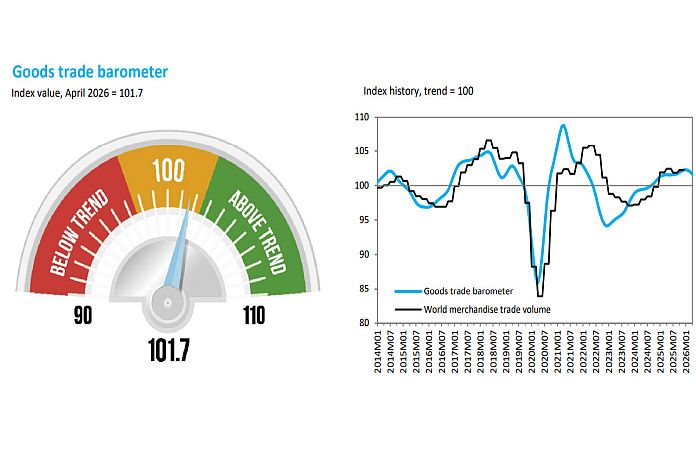
The Goods Trade Barometer is a composite leading indicator for merchandise trade, providing an early indication of the trajectory of world trade relative to recent trends. Barometer values greater than 100 are associated with above-trend trade volumes while values less than 100 indicate that the volume of trade has fallen below trend.
The current reading of 101.7 for the barometer index (represented by the blue line in the above chart) is down slightly from its January value of 102.3, suggesting that merchandise trade growth may be starting to slow. The barometer index is also above its baseline value of 100, indicating that the volume of trade currently remains above trend. Actual quarterly trade volumes, represented by the black line, have been above trend since the start of 2025. The negative impact of the Middle East conflict may have been partly offset by surging demand for electronic components related to AI investment, as evidenced by the Drivers of goods trade chart.
The barometer’s component indices are all near their common baseline value of 100, except for the electronic components index (105.5), which has risen firmly above trend. The agricultural raw materials index (98.9) and automotive products index (99.8) are both slightly below trend, while the highly predictive export orders index (100.5) is slightly above. The indices related to the transport of goods, including air freight (102.2) and container shipping (102.4), continue to signal expansion, although at a slower rate than a few months ago. On balance, the indices show signs of resilience, signalling relatively stable global merchandise trade growth.
The WTO Secretariat’s most recent Global Trade Outlook and Statistics (GTOS) report of 19 March predicted merchandise trade growth of 1.9 percent in 2026 under a baseline scenario, or 1.4 percent under a high energy price scenario reflecting headwinds from the Middle East conflict, while sustained investment in AI could add 0.5 percentage points to the growth rate. The next WTO trade forecast is scheduled for release in October 2026.
Year-on-year growth in the volume of world merchandise trade rose sharply in the first quarter of 2025 as importers accelerated purchases ahead of anticipated tariff hikes. Growth slowed in the remainder of the year but still came in stronger than expected, as demand for AI-enabling goods surged.
- The full Goods Trade Barometer is available here. Further details on the methodology can be found in the technical note here.
About the Author