



- The General Agreement provides the framework for the implementation of programs and projects related to rural development, productivity, sustainability, agricultural health and safety, and food security.
- The 2026-2028 AGRICULTURA-IICA Collaboration Plan prioritises actions aimed at modernising livestock traceability, strengthening health intelligence, and improving animal health prevention and response measures.
- The strategic projects include the IT System for Animal Identification and Traceability in Mexico and the Regional Health Intelligence Center for New World Screwworm in Cattle, with an investment of roughly USD 6 million.
MEXICO CITY, San Jose – The Secretariat of Agriculture and Rural Development (AGRICULTURA) and the Inter-American Institute for Cooperation on Agriculture (IICA) signed a General Cooperation and Project Management Agreement designed to strengthen technical cooperation targeted at the agrifood sector, the well-being of rural communities, and the food sovereignty of Mexico.
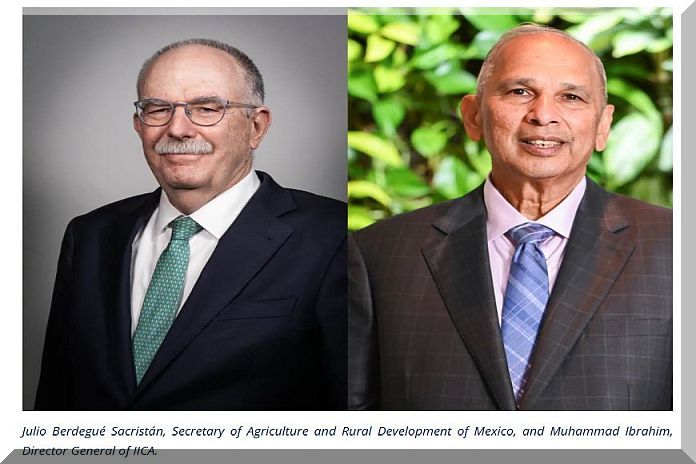
The document, which was signed remotely by the secretary of agriculture and rural development of Mexico, Julio Berdegué Sacristán, and the director-general of IICA, Muhammad Ibrahim, will run until March 2031.
The agreement provides the framework for the implementation of programs and projects aimed at rural development, increased productivity, agrifood system sustainability, agricultural health and safety, and food security, in line with the government of Mexico’s vision of creating a fairer, more resilient rural sector equipped to guarantee sufficient quality food for the population.
The lines of cooperation will include capacity building, strategic planning, agricultural, aquaculture and fisheries health, the strengthening of agrifood chains, the adding of value, marketing and water efficiency in agriculture, all key components of the efforts to make the sector more sustainable, competitive, and inclusive.
AGRICULTURA and the IICA office in Mexico, through its representative, Diego Montenegro Ernst, also signed the 2026-2028 Agriculture-IICA Collaboration Plan, which marks the continuation of a technical cooperation agenda based on IICA’s experience in innovation, capacity building and regional coordination, in support of the strategic priorities of Mexico’s agrifood sector.
The plan also calls for a comprehensive strategy aimed at controlling and eradicating the New World Screwworm (NWS) in cattle, promoting animal health innovations through the introduction of epidemiological intelligence tools, digitalisation, and technological development, and institution building and regional coordination to protect animal health and livestock production.
Two projects are being prioritised. The first is an initiative to strengthen animal identification and traceability in Mexico, focused on the development, integration, and modernisation of livestock registration systems. This tool will incorporate advanced analytics and artificial intelligence to strengthen epidemiological surveillance and support decision-making in animal health.
The second project is the Regional Health Intelligence Center for NWS, a joint initiative with Central American countries designed to strengthen the prevention, surveillance and control of the pest by means of an epidemiological intelligence platform, the standardisation of protocols, and the strengthening of technical capabilities.
The two projects, which entail an investment of roughly USD 6 million, will help strengthen regional cooperation in agricultural security.
With these instruments, the Secretariat of Agriculture and Rural Development and IICA reaffirm their commitment to promoting more resilient, sustainable and inclusive crop and livestock farming, which will enhance producers’ wellbeing, contribute to food sovereignty, and consolidate Mexico’s capacity to protect its production against health risks and regional challenges.